Our YouTube Channel

We’ve decided to get our YouTube channel going in earnest.  We’re going to put a log of our visually oriented case material there, as well as training and public education material. Right now, there isn’t much, but we’ll be building it up and improving the channel over the next few months. We’ll also be improving the artwork and overall feel. The more long form content that doesn’t require anything visual will remain on the podcast.

We hope you’ll hit the subscribe button so you’ll be notified about new content as we add it.

Unidentified Science 4 – Smarter than we are?

As I promised at the end of Unidentified Science 3, this time I’m going to take a little break this time from talking about virtuous scientific work. Such work is hard, slow and often reaches a Great Divide where no progress seems possible, but we have gone too far to quit.

So, it’s good to have a little fun once and awhile and indulge in speculation. As long as you clearly label speculation as just that, there is no harm in it, and these little imaginative expeditions can often stimulate really useful new ideas.  After all, that’s one thing science fiction is good for. Like good science fiction, we want our speculations to be informed by the best science we have, admitting that there are leaps across the gap of our ignorance that are simply made up for the amusement of thinking about it.

Continue reading

Field Investigation gear – notes on cameras

All those reviews

I’ve been researching digital cameras quite a lot lately. I need something that produces better and more repeatable results than my smartphone, but I had to give this quite a lot of thought. There are a lot of very good, thorough photography and videography reviews out there, but you have to listen between the lines – what sort of results is this reviewer interested in? Chances are, the reviewer is going for an aesthetically pleasing result, whether the subject be brides or birds. There is nothing wrong with that, but the review is most often from that point of view. What we as field investigators are looking for is something different. So, when doing your research, keep that in mind.

Too Many Choices
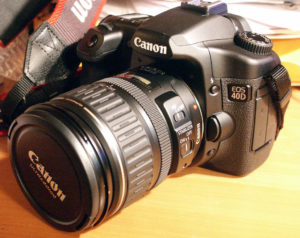
The venerable Canon EOS 40D

Camera technology has vaulted ahead since I bought my Canon EOS 40D years ago – the last time I really looked into this. BTW, my EOS 40D is built like a tank and is still in great condition. Almost every camera shoots video now, and there are a wide range of options. Olympus, Panasonic and Sony have broken into the higher end of things alongside Canon and Nikon with some really good gear, and the old DSLR architecture has serious competition from the more compact mirrorless cameras. Things like autofocus, video resolution, and low light sensitivity have come a long way.

This is overall a good thing, but it’s like being in a candy store and your mom says you can only have 1 handful – it can be agonizing. you can do a lot to narrow things down by not starting with the technology, but with what your requirements are. Let me make a few suggestions.

Getting to What We Actually Need

You have to consider a few Design Reference Missions – in what scenarios do you need a camera, and in what conditions? There are the common uses, and some extraordinary but important circumstances when you want to be ready for anything:

Continue reading

Unidentified Science 3 – Perception and Memory

I started off this series by talking about four virtues I think we are going to have to live by if the study of UFOs is ever going to be accepted as a science: humility, patience, integrity and skepticism. This one is a little bit about skepticism, but mostly about patience.

There is a big problem in Unidentified Aerial Phenomena research that needs to be addressed before we can make any claim of being a scientific enterprise. We are going to need a lot of patience to solve it. The problem is that much, in fact nearly all of our database is eyewitness testimony.

While our research has keep pretty much the same approach as always, science has marched on, and this includes the studies of human perception and memory.

Continue reading

Change to the Sighting Report Form

In the last few months, we have worked to improve the sighting report form to make it friendlier and easier to understand. Previously, we had a check box on the form to request anonymity. We have changed that.

We assume you want anonymity, and we will protect your anonymity and privacy. Period.

If you want your real name or other identifying information about you used in our public materials, then you will need to tell us that in writing, but we will not otherwise release this information to the public.

However, as explained in the policy,  it is possible that we will want to share your case file (which may include your contact information) with other ethical investigation groups. This is unlikely in most cases, but it could happen. We want to assure you that it will not happen without your permission. The new checkbox on the report form gives you the option of requiring us to specifically ask you if the transfer is OK with you before we do it (check “No”). if you check “Yes”, then we may (but probably won’t) share your file with other organizations if they are well vetted and have a written ethics agreement with us. We will always inform you when we do this.

Update: the checkbox has been removed. From now on the policy is to ask ALL witnesses for permission before sharing their case file with anyone.

Questions? Comments? Let us hear from you.

New for 2018 – Full Reports of Investigation (ROI)

Starting with this calendar year, we will publish our Reports of Investigation on this site, redacted of any possible witness Personally Identifying Information (PII). The data in these reports are not the story – often there is much more in the way of photos, videos, and detailed analysis.  Interested parties can contact us for full resolution photos and other details.

Witness PII will NOT be released without witness permission, and only to those persons of verified identity with whom we have an agreement on investigatory ethics.  Contact us if you need to discuss this.

We’re Reaching Out

Case 15-029 – not a hoax, but what is it?

We at API recognize that we’re unlikely to accomplish much by ourselves.  API is, after all, not an end in itself. As soon as an organization starts to exist for its own sake, it’s simply  a matter of time before its original vision is lost or even perverted. API only makes sense to the extent it makes a contribution to the overall vision.

As we see it, our overall strategy is competently investigating many vetted cases, and then looking for telling patterns in the highest probability cases, we are going to have to be part of a bigger network.The larger aim is to begin to ask better questions that ca be scientifically addressed. Grand theories can wait – we don’t even have good hypotheses yet.

To make this work, we need to establish links with other groups that perform quality, ethical  investigations and share data in a way that does not violate a witnesses’ need for anonymity.

In addition to the slow, careful process of adding new field investigators, there are other sorts of alliance that can work. We can share cases when all other requirements are met, or anonymized case data otherwise.  Just as importantly, we can share knowledge and skills.  Skills in areas like video forensics, tracking down long lost corroborators, or analyzing ATC audio tapes could be shared among small organizations worldwide.

One of the hoax photos from Argentina

In one case a few years ago, it was an Argentine UFO research group who found an object that exactly matched what we were seeing in a set of photographs, and this helped us conclude that the photos were probably hoaxed.

Eliminating hoaxes and misidentifications is an important part of this work – removing the “ordinary noise.” There is also “sophisticated noise,” as Hynek once pointed out, that may be part of the signal. Since we don’t know what the signal is, we need to help each other. I’m sure I don’t have a complete list of all the ways this can work.

What do you think?